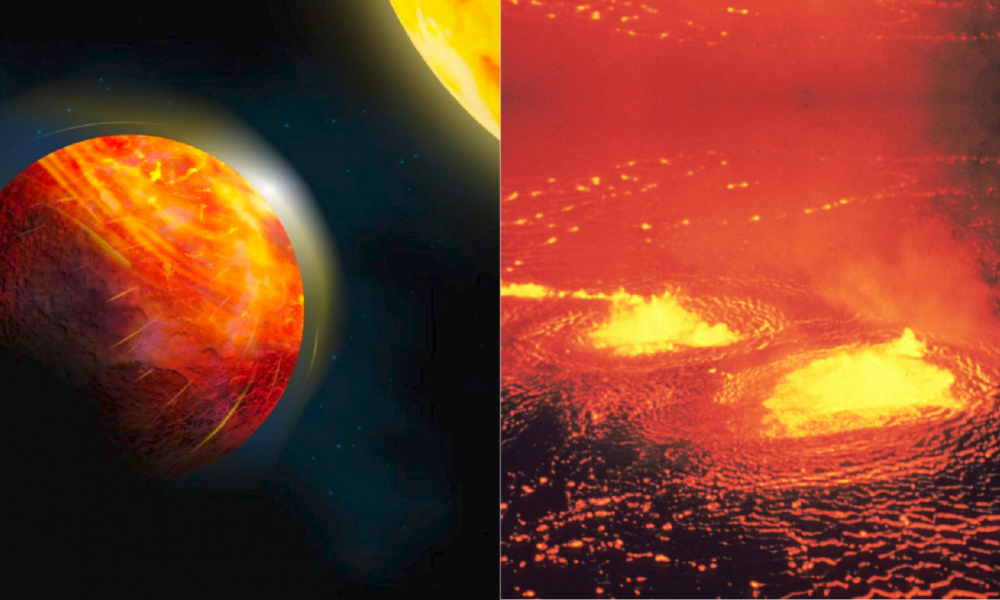
Scientists have found a strange planet far from Earth. It is often called a “planet hell.” The real name is L 98-59 d. It sits about 35 light-years away. That is close in space terms, but still far beyond reach.
This planet is very different from Earth. It is not covered with land, water, or ice. Instead, scientists think most of its surface is made of molten rock. That means it may look like a glowing ocean of lava.
Temperatures can reach about 1,500°C. In some cases, it could be even higher. At this level, rocks melt and stay liquid. There is no stable ground like we have on Earth.
Why the planet is so hot
This planet is very close to its star. The star is a red dwarf, smaller than our Sun. But distance matters more than size here. L 98-59 d orbits so close that one year there is very short. It gets a huge amount of heat all the time.
It may also be tidally locked. This means one side always faces the star. That side would be even hotter. The other side might be cooler, but still very hot compared to Earth.
And the scientists think it contains gases like hydrogen sulfide. That is the gas that smells like rotten eggs.
There may also be other gases released from molten rock. When rock melts, it releases chemicals into the air. Over time, this builds a thick atmosphere.
This leads to something called a runaway greenhouse effect. Heat enters but cannot escape easily. The atmosphere traps it. So the planet keeps getting hotter or stays hot for a long time.
This planet may not be fully solid

Most rocky planets have solid surfaces. Earth has a solid crust. Under that, there is hot material, but the surface stays stable.
L 98-59 d may be different. Scientists think a large part of it could be molten, not just the top. Some researchers say it may not fit the usual “rocky planet” label. It might be part of a group called lava worlds or molten planets.
How scientists discovered it
This discovery was made by scientists at the University of Oxford, who used the James Webb Space Telescope (JWST) along with ground-based observatories.
They studied how light changes when the planet passes in front of its star. This helps them understand the planet’s size and atmosphere.
Scientists also used computer models. These models simulate how the planet formed and changed over time. It helps them understand what is happening deep inside, even though they cannot see it directly.
This planet cannot support life. The heat is too high. The air is toxic. There is no liquid water.
But it still matters.
It shows that the universe has more variety than we thought. There may be many planets like this, and we are just starting to find them.
It also helps scientists understand how planets form. All rocky planets, including Earth, likely started as molten worlds. Over time, they cooled down.
So, by studying L 98-59 d, scientists may learn more about Earth’s early history.