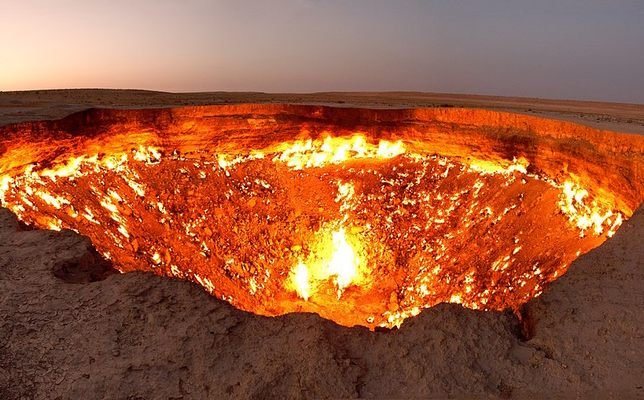
The story begins in 1971 when Soviet scientists were drilling in the desert, searching for natural gas. Suddenly, the ground beneath their equipment collapsed, swallowing the rig and creating a massive crater.
What emerged from the depths was dangerous: methane gas started leaking into the air. Methane is highly flammable, toxic, and explosive. To prevent a disaster, scientists made a bold decision — they set the crater on fire.
Their plan was simple: burn off the methane in a few days.
It didn’t work.
Instead, the fire continued to blaze. Weeks turned into months. Months turned into decades. And today, more than 50 years later, the crater still burns.
So why hasn’t the fire died out?
The answer is buried beneath the surface.
The crater sits atop a vast natural gas reserve. As methane continues to seep from underground pockets, it fuels the flames constantly. In essence, the Earth itself is feeding this endless fire.
Scientists admit that as long as this gas remains, the fire could theoretically burn forever. This makes the Gates of Hell not just a geological curiosity, but also one of the most persistent human-induced natural fires on the planet.
For anyone standing near it, the experience is otherworldly. No wonder it earned the nickname “Gates of Hell.”
Photographers travel from across the world to capture its hellish glow in long-exposure shots, often framing it with stars and desert dunes for dramatic effect.
Attempts to Control the Fire
Over the decades, officials have explored ways to control or extinguish the blaze. Plans included filling the crater with sand or concrete.
However, engineers realized that the fire is virtually unstoppable as long as the methane supply continues. Any intervention could risk underground explosions or the release of toxic gas.
This makes the Gates of Hell one of the longest-lasting human-induced fires in the world.
While the crater is a spectacular sight, it’s also a massive waste of natural resources. Every day, thousands of cubic meters of methane are released into the atmosphere instead of being used for energy.
Methane could theoretically supply a small town with electricity if it were captured. Turkmenistan’s government has explored ways to harness this gas, but engineering obstacles and safety concerns have made it impossible.
Travelers Flock to the Gates of Hell
Anyway, the Gates of Hell has become one of the world’s most unusual tourist destinations. Tourism has surged due to social media, photography, and viral videos. Visitors from across the globe travel to the Karakum Desert to witness the fire that has been blazing for over 50 years.
Sources:
https://www.ncl.ac.uk/nes/people/profile/markireland.html
https://profiles.imperial.ac.uk/g.rein
https://profiles.imperial.ac.uk/g.rein