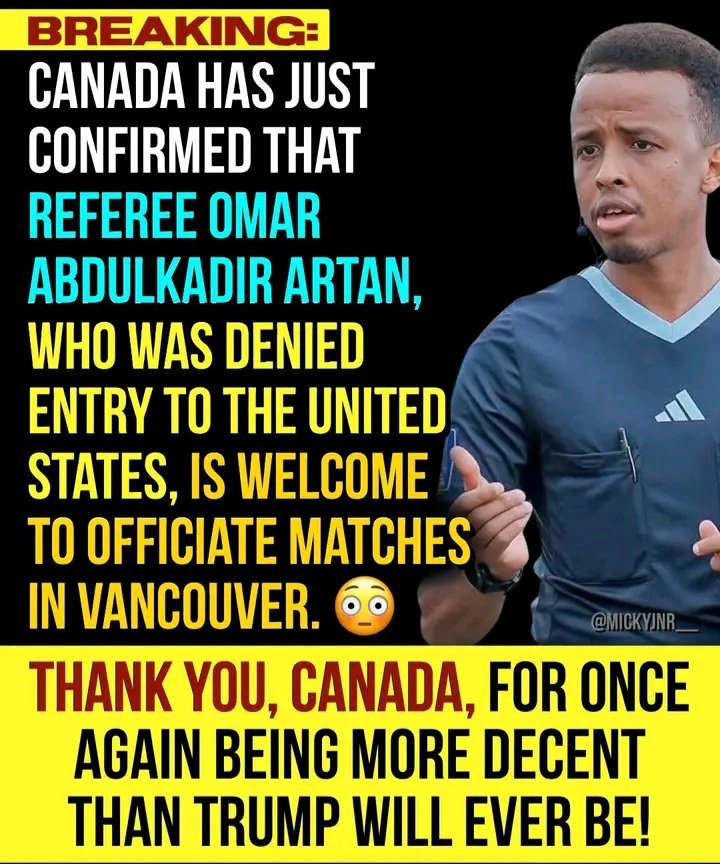
The 2026 FIFA World Cup has encountered a major immigration controversy that goes far beyond the soccer pitch. Somali referee Omar Abdulkadir Artan, who was set to make history as his nation’s first-ever World Cup match official, was abruptly denied entry into the United States. However, the story took a supportive turn when Canadian officials publicly welcomed Artan to Vancouver.
This stark contrast in international border policies has sparked widespread online discussions, turning a sports headline into a major political talking point.
Why Was Omar Abdulkadir Artan Denied US Entry?
Despite holding a diplomatic passport and being one of the 52 referees officially selected by FIFA, Artan’s World Cup dream was cut short at Miami International Airport.
The Detainment: US Customs and Border Protection (CBP) detained Artan upon arrival, citing “vetting concerns” and questioning him about alleged associations with terror organizations—claims he entirely refuted.
The Deportation: Following the interrogation, he was deemed inadmissible under US immigration laws and placed on a flight back out of the country.
FIFA’s Response: FIFA confirmed Artan was dropped from the officiating roster, noting that host governments ultimately control their own visa and border entry processes.
Canada’s Response: Welcome to Vancouver
In sharp contrast to the US denial, Canadian leaders offered a drastically different approach. British Columbia Premier David Eby took to social media to support the Somali referee, stating that Artan would be “welcomed and celebrated in British Columbia.” Eby extended an open invitation, suggesting, “Let’s have him referee in Vancouver.”
While FIFA’s strict mandatory training requirements in Miami meant Artan couldn’t officially step in to officiate the World Cup matches in Canada, the symbolic gesture of Canadian hospitality resonated deeply with fans globally.
The Political Backlash and Social Media Reaction
The contrasting actions of the US and Canada have ignited a massive reaction online. Viral posts—like the one circulating about Canada being “more decent” than Donald Trump’s administration—highlight the deep political undertones of this event.
Recently enacted travel restrictions on Somali nationals by the Trump administration played a central role in Artan’s denial. Consequently, supporters have used this incident to heavily criticize US border policies while praising Canada for its inclusivity and decency.
Conclusion
The unfortunate situation surrounding Omar Abdulkadir Artan highlights the complicated intersection of global sports and strict national politics. While his 2026 FIFA World Cup journey was derailed by US border control, the warm welcome from Vancouver and the global solidarity he received prove that his achievements on the field are widely respected.