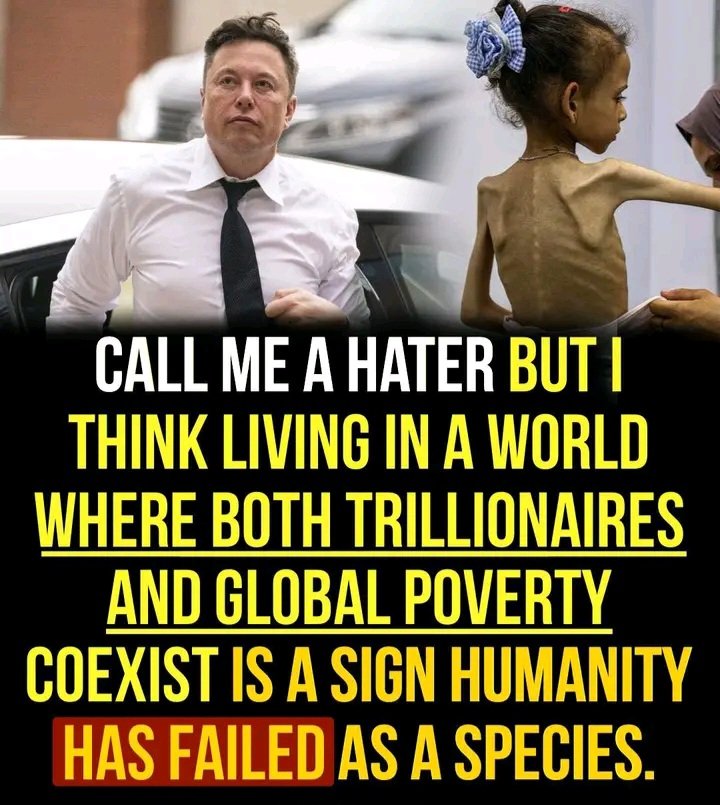
A thought-provoking image often circulates on social media, featuring a stark visual contrast: on one side, Elon Musk, one of the world’s wealthiest individuals, and on the other, a severely malnourished child. The accompanying text reads, “Call me a hater but I think living in a world where both trillionaires and global poverty coexist is a sign humanity has failed as a species.” This powerful meme effectively highlights one of the most bitter realities of our modern world: extreme economic inequality.
First, a point of factual correction is necessary. While the meme uses the term “trillionaires,” as of today, no single individual has officially reached trillionaire status. However, the underlying point remains profoundly relevant. The staggering wealth amassed by billionaires—often exceeding the Gross Domestic Product (GDP) of entire developing nations—contrasted with the devastating reality of extreme poverty, raises critical moral and ethical questions about the fairness of global resource distribution.
Capitalism and technological advancement have undeniably driven global economic growth and groundbreaking innovation. Yet, these systems have also fueled an immense concentration of wealth. Today, we live in a reality where billions of dollars are poured into space exploration and cutting-edge technology, while millions of people across the globe still lack access to basic necessities like clean drinking water, adequate food, and basic healthcare. This stark divide points to a deep, systemic flaw in our global economic priorities.
Ultimately, this viral image serves as a harsh wake-up call. Wealth accumulation and innovation are not inherently negative, but as long as a massive portion of the global population battles starvation and absolute poverty, our collective progress remains tragically incomplete. While claiming “humanity has failed” might sound overly pessimistic, the sentiment forces us to critically re-evaluate our humanitarian values, the social responsibility of the ultra-wealthy, and the urgent need for a more equitable global system.