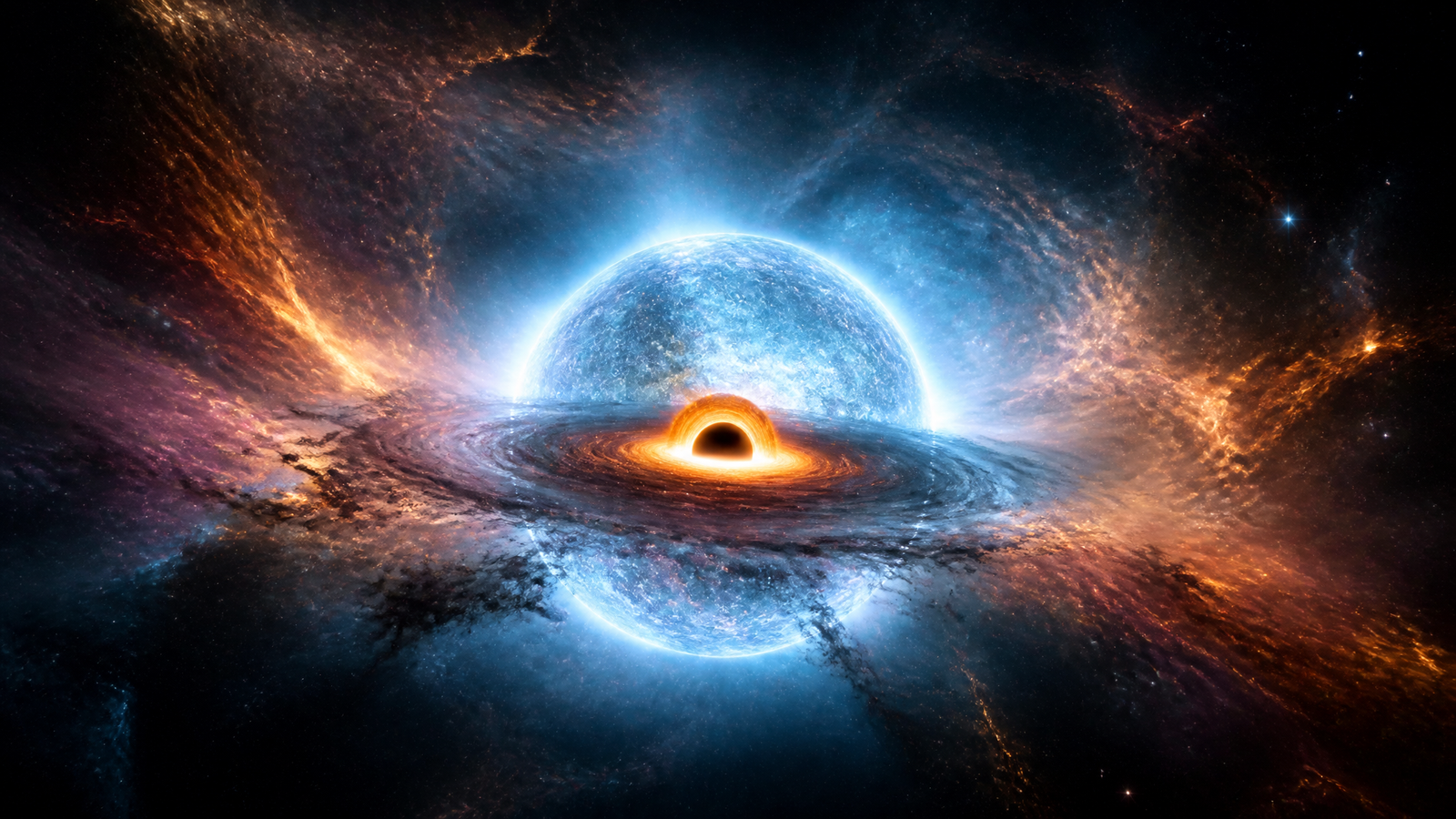
A black hole is an object whose gravitational pull is so strong that nothing, not even light, can escape it NASA. That single fact is the reason these objects are among the strangest things in the universe — and the reason their formation is a story about a star losing a fight with its own weight.
The short answer
Most black holes we can observe began as very massive stars. When such a star exhausts the nuclear fuel in its core, the core can no longer hold itself up against gravity. It collapses, the outer layers are blown away in a supernova explosion, and if enough mass remains packed into a small enough volume, the collapse continues until a black hole forms NASA.
Why a star doesn’t collapse immediately
A star is a balance between two enormous forces. Gravity pulls every atom inward. Meanwhile, fusion reactions in the core release energy that pushes outward. For most of a star’s life those forces are in equilibrium, and the star is stable. When the fuel runs out, the outward push disappears. Nothing remains to support the core, and gravity takes over.
The three mass thresholds that decide the outcome
What happens next depends almost entirely on how much mass the dying star’s core contains.
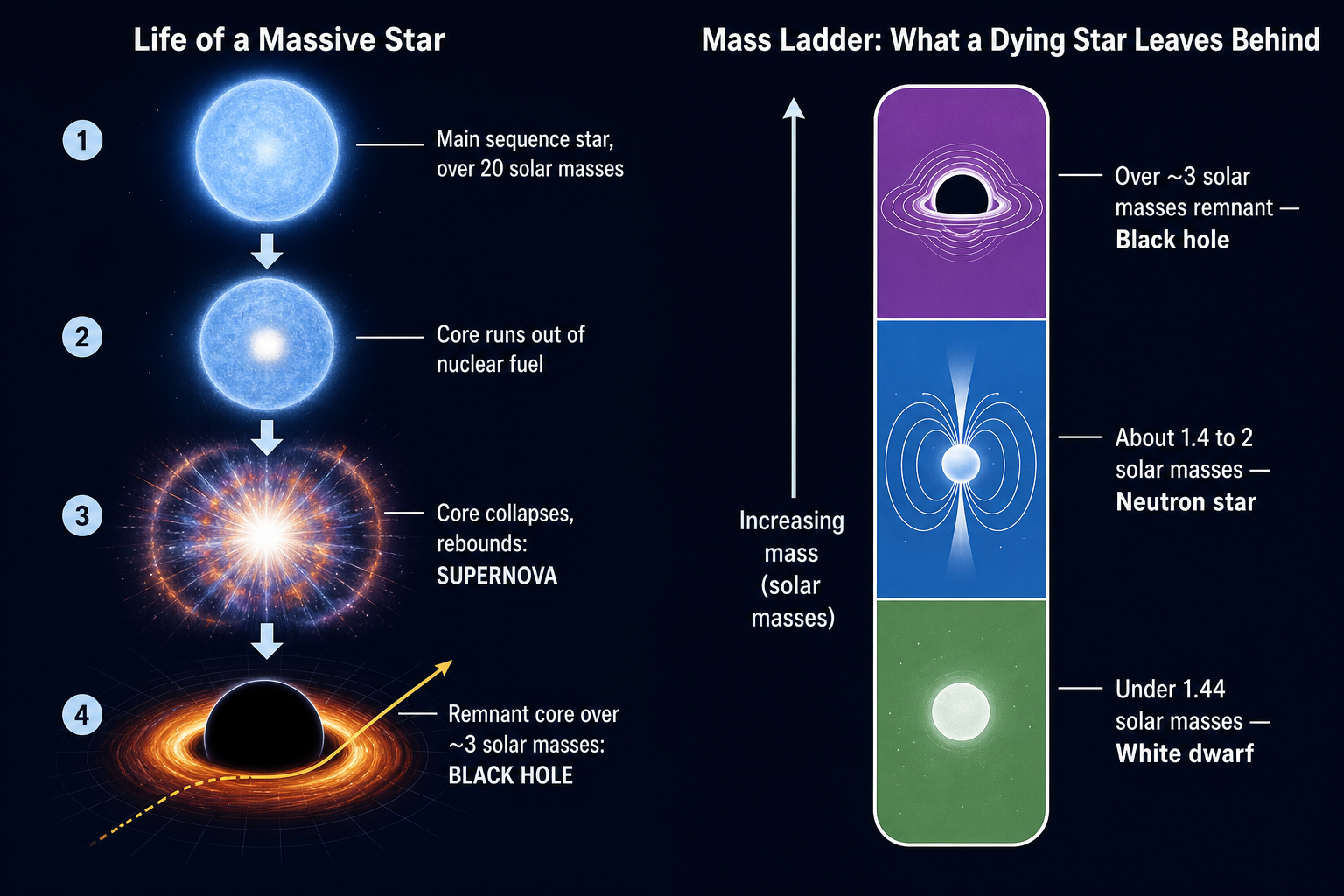
Below about 1.44 solar masses: a white dwarf. If the leftover core is relatively light, electron pressure can halt the collapse. The result is a white dwarf, an Earth-sized ember. The maximum mass a white dwarf can support is the Chandrasekhar limit, approximately 1.44 times the mass of the Sun.
Roughly 1.4 to 2 solar masses: a neutron star. If the core is heavier, electrons are forced into protons and the remnant becomes a neutron star — a city-sized sphere of nuclear matter. Observed neutron stars mostly fall between about 1.4 and 2.0 solar masses, with an upper bound known as the Tolman–Oppenheimer–Volkoff limit.
Above about 3 solar masses of remnant: a black hole. Beyond the neutron star limit, no known force can stop the collapse. NASA puts the decisive figure this way: if the crushed core contains more than about three times the Sun’s mass, nothing halts its collapse into a black hole.
The full sequence, step by step
- A massive star forms. Stellar-mass black holes come from stars with more than about 20 times the Sun’s mass at the relevant stage of their lives.
- The core burns through its fuel. Fusion builds an inert iron core that cannot release energy by fusing further.
- The core collapses. Without fusion pressure, the iron core falls inward in a fraction of a second.
- The collapse rebounds and explodes. NASA describes the sequence as the core collapsing, rebounding, and exploding as a supernova, which blows off the star’s outer layers.
- The remnant either stands or falls. A modest remnant yields a neutron star; a core heavier than roughly 20 solar masses has produced a stellar-mass black hole.
Not every massive star explodes cleanly
Astronomers believe stellar black holes can form in two broad ways: some form when a massive star collapses directly into a black hole, and others form after a supernova leaves behind a heavy enough core. In the first case, the star may simply vanish rather than produce a bright explosion. The exact boundary between the two pathways remains an active area of research.
Where the big black holes come from
Stellar collapse explains stellar-mass black holes, which range from a few to perhaps hundreds of solar masses. It does not explain the giants. Almost every large galaxy, including the Milky Way, has a supermassive black hole at its centre, with masses from hundreds of thousands to billions of Suns. The one at the centre of our galaxy, Sagittarius A*, weighs about 4 million solar masses.
How these formed is still poorly understood, though observations show some already existed in the first billion years after the birth of the universe. Astronomers also suspect an in-between class, intermediate-mass black holes, ranging from about one hundred to tens of thousands of solar masses — the so-called missing link.
What happens after formation
A black hole does not stay the same size. Once born, black holes grow by accreting matter, including gas stripped from neighbouring stars and even other black holes. Matter spiralling inward heats up to millions of degrees and radiates X-rays and radio waves, which is how astronomers detect black holes indirectly. Some material is hurled away in jets moving near the speed of light. The boundary of no return is the event horizon: the surface where the escape velocity exceeds the speed of light, the speed limit of the cosmos.
FAQ
What size star becomes a black hole? A star with more than about 20 solar masses can leave behind a stellar-mass black hole after its core collapses.
Does our Sun become a black hole? No. Our Sun is far below the mass needed, so it is expected to end as a white dwarf.
What decides between a neutron star and a black hole? The mass left in the core after the supernova. A remnant above roughly three solar masses cannot be supported and collapses.
Can a black hole form without a supernova? Yes. Some may form by direct collapse, without a bright supernova Mirabel 2017.
How do we know black holes exist? Through X-ray and radio emission from accretion disks and jets, gravitational waves from mergers, and the 2019 Event Horizon Telescope image of the black hole in galaxy M87.